
Dennis opposed certain cultural practices in Egbu that he believed conflicted with Christian principles and insisted on their discontinuation. Among these practices was the Mbari tradition, which Dennis and his team destroyed.
On January 25, 1910, the elders of Egbu visited Dennis to discuss the Ulo Mbari, fully aware of his strong objections. They expressed concern about offending him but were also in deep fear of the vengeance of Ala should they fail to rebuild the structure in her honor, believing this would result in increased deaths and decreased births. Dennis attempted to explain that life and death were not controlled by Ala or any other idol and stated that he was willing to accept responsibility for any consequences resulting from their refusal to rebuild. The elders proposed that Dennis sanction one or two key elements of their idol worship, promising in return to abandon all other practices and attend church regularly. Dennis refused to compromise, a decision that clearly disappointed them.
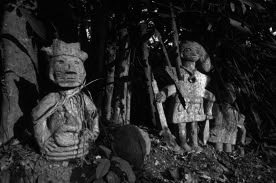
The concept of Mbari houses originates from the deep reverence of the Igbo people for Ala, the goddess of fertility, morality, and the earth. These structures were often built following periods of calamity, such as drought or epidemics, as offerings intended to appease the gods. The act of constructing a Mbari house was considered as significant as the structure itself, symbolizing renewal, communal unity, and spiritual harmony (Okonkwo, 2015).
The Ogirishi was used in shrines to honor the oldest lineage settlers and was believed to repel evil and prevent misfortune from entering neighboring homes. It was planted for newborn children as their chi for protection and became their personal idol. Evil individuals were believed to avoid the Ogirishi, reinforcing its role as a natural safeguard for families. Its leaves were used in water for bathing as part of spiritual cleansing rituals and were also used to support women during childbirth and to promote milk production in nursing mothers.
Dennis and his team insisted that a condition for baptism was the uprooting and presentation of the Ogirishi idol for destruction. Every baptismal candidate was required to bring their idol for destruction before entering the baptismal class.
The Arochukwu Long Juju (Ibini Ukpabi Oracle)
Dennis and his team visited a well-known shrine with a dark reputation called the Ibini Ukpabi Oracle, also known as the Long Juju of Arochukwu. People traveled there to consult the deity, but many never returned, with some reportedly sold into slavery.
They described the site as a steep ravine leading down to a wooden structure beside a stream of clear water. Among dense foliage and broken weapons, they discovered a human skull bearing a knife wound. A young guide explained that those seeking the god were required to enter empty-handed, bringing only a small offering such as kola.
The descent path was used by the Arochukwu people to lead visitors to what was known as the House of God. Individuals consulting the oracle were often blindfolded and heard a distant voice believed to be that of the god, produced by a priest using a clay pot. The Ibini Ukpabi oracle was situated deep within the forest of Arochukwu, reinforcing its secluded and ancient character.
Guarding the site was the cult statue of Kamalu, the warrior god. A central feature of the oracle was a narrow gully, approximately six feet wide, which grew darker and more confined as it approached the cave entrance. Within the deep cave lay the “Holy of Holies,” regarded as the seat of the oracle’s judgment.
Nearby was a waterfall whose loud sound could be heard from afar and was believed to be the prophetic voice of Ibini Ukpabi. Another key element was the Red River (Iyi-Eke), which observers believed carried the blood of the condemned. The Aro people reportedly colored the water red to create the impression that those condemned had died.
There was also the Hill of Rags, where individuals judged guilty were made to strip and leave their clothing behind. Blindfolded victims were then led to Onu Asu Bekee (the European beach), where waiting boats transported enslaved individuals to Calabar and onward to Ala Bekee (the white man’s land).
Despite its dark associations, the oracle was regarded as the dwelling place of Chukwu, the great spirit. People from across Igbo land brought disputes to be judged before the oracle. Others were kidnapped, brought to the site, and sold into slavery. The British government later destroyed the site associated with these beliefs.